Lesson 14 of 23 · LLM preliminaries capstone

Place every component on one model map.

Your win: follow token IDs to logits, separate architecture from training stages, and explain how pretraining, supervised fine-tuning, and generation use the same decoder.
20 minutesNeeds: Lessons 10–13Outcome: enter Module 3 with context
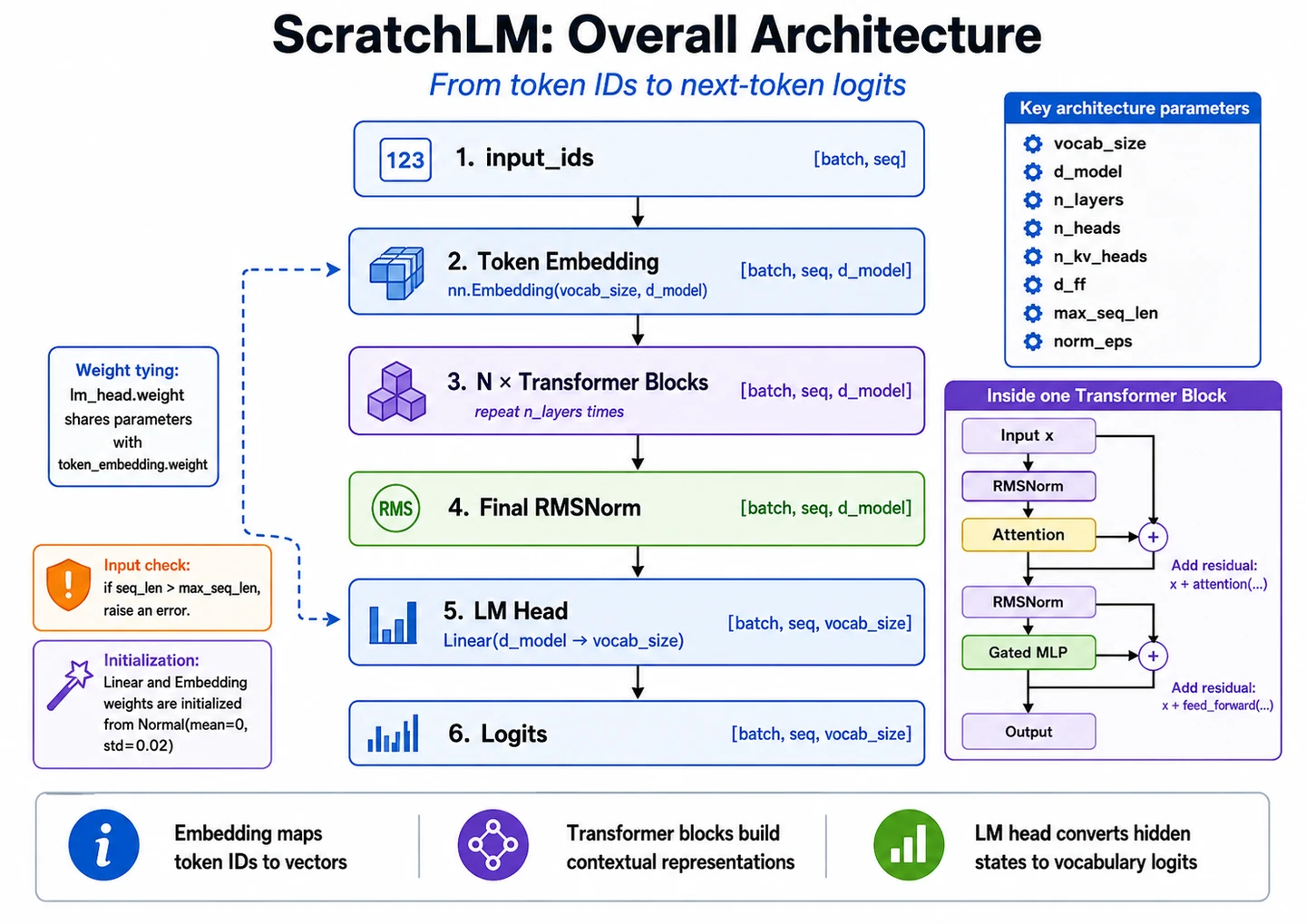
Module bridge: the next nine lessons open the purple “Transformer blocks” stage below and explain every operation inside one block.
Decoder-only language model architecture from token IDs through embeddings, repeated Transformer blocks, final RMSNorm, language-model head, and vocabulary logits
The residual stream keeps shape \([B,T,D]\) through the block stack. The language-model head changes the final axis from model width \(D\) to vocabulary size \(V\).

Keep a five-line shape ledger

StageShapeWhat changes
Token IDs\([B,T]\)Discrete vocabulary indices
Token embeddings\([B,T,D]\)Add one learned feature vector per token
\(N\) decoder blocks\([B,T,D]\)Build contextual representations while preserving the residual shape
Final normalization\([B,T,D]\)Rescale each token's features
LM head logits\([B,T,V]\)Score every vocabulary token at every position

One architecture supports several training stages

1 · Pretraining

Learn broad language patterns from next-token prediction over large text corpora.

Objective: predict the continuation.

2 · Supervised fine-tuning

Continue next-token training on structured prompt-response demonstrations.

Objective: imitate useful responses.

3 · Preference alignment

Use preference data or rewards to favor responses judged more helpful and safe.

Objective: improve behavioral choices.

The model still produces next-token logits in every stage. What changes is the data, loss construction, or optimization procedure.
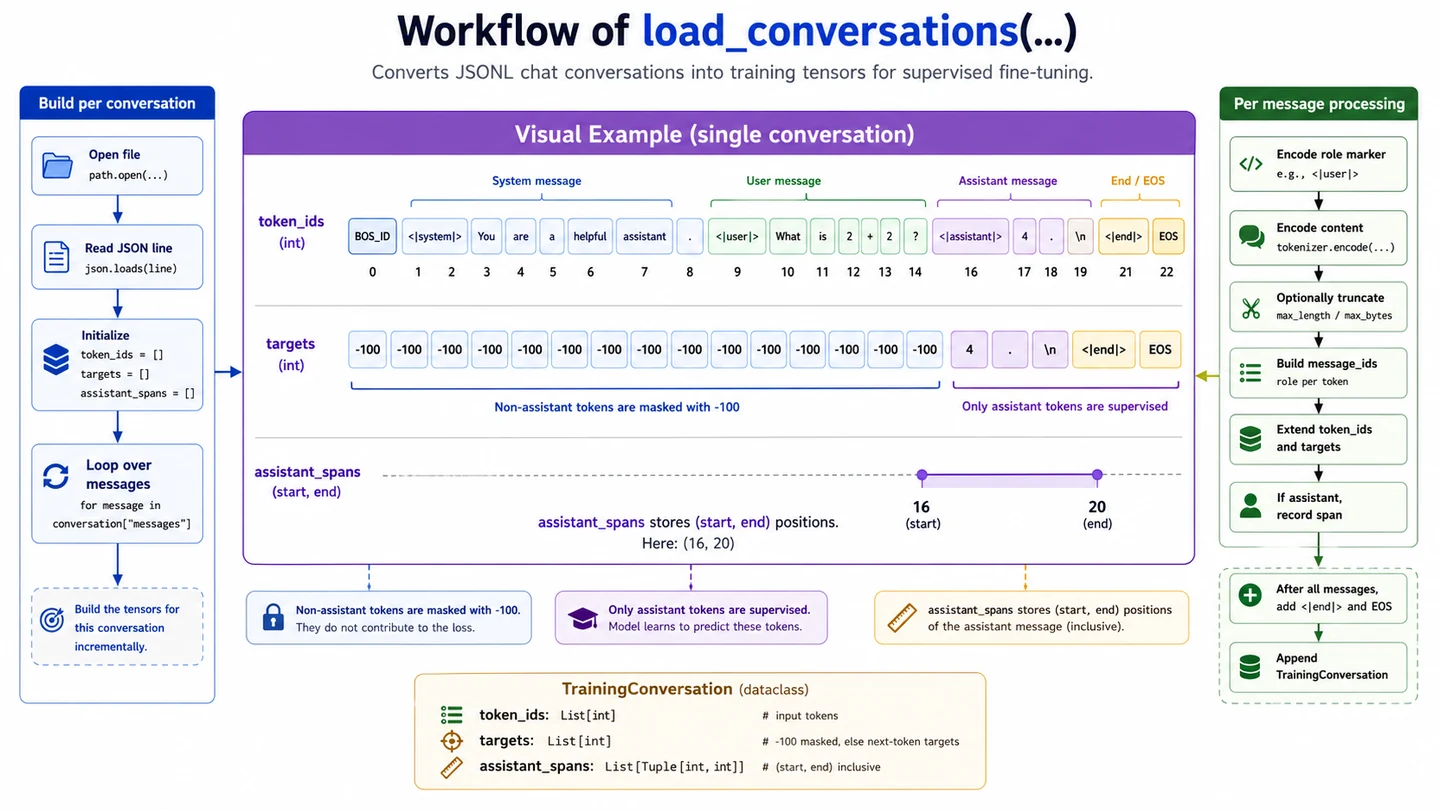
Optional implementation view · how chat messages become supervised tensors
Workflow converting system, user, and assistant messages into token IDs and completion-only training targets
Completion-only SFT commonly masks system and user targets, so only assistant response tokens contribute to the loss.
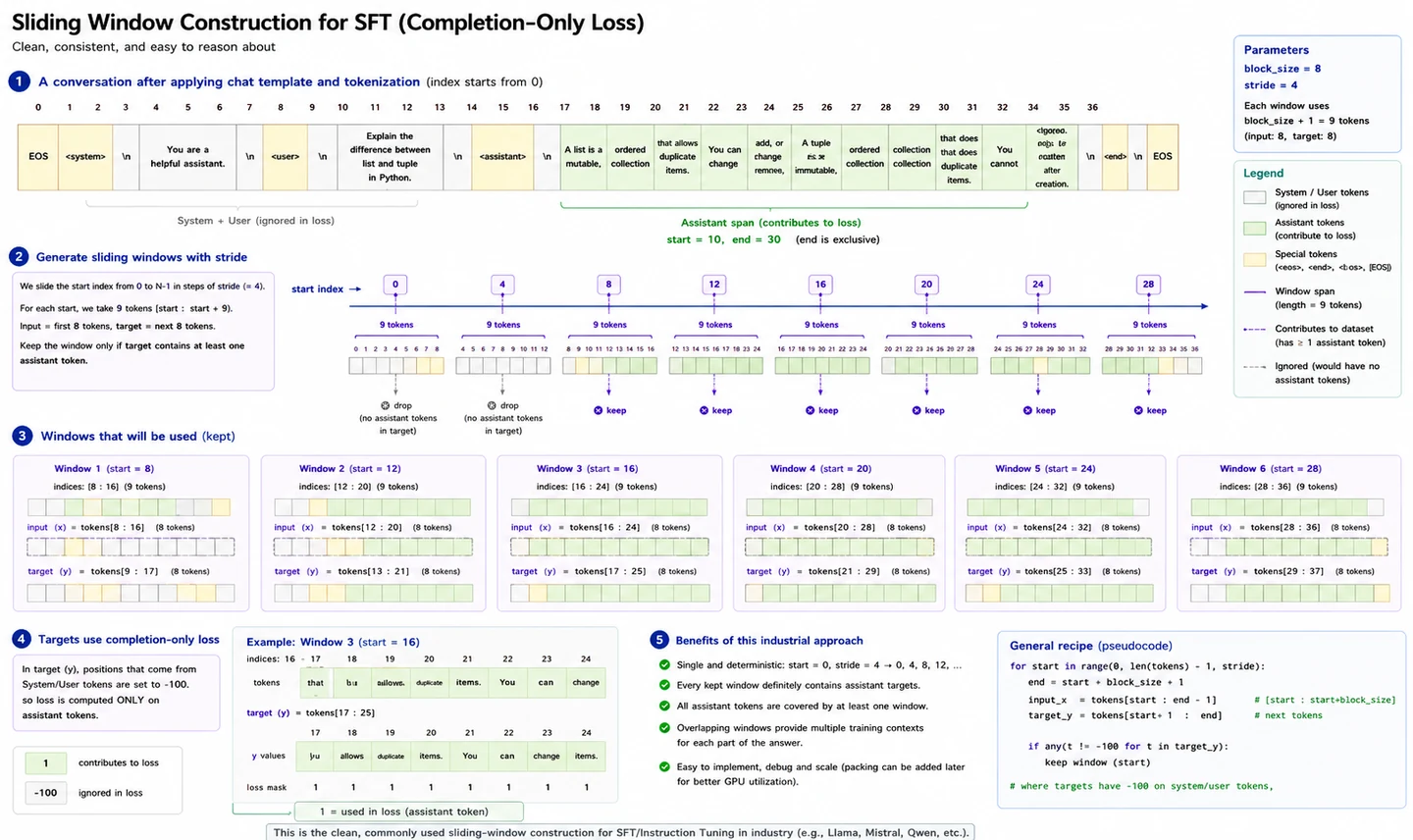
Optional implementation view · long conversations become training windows
Sliding-window construction for long supervised fine-tuning conversations with assistant-only loss masks
Overlapping windows fit long conversations into a fixed context length while retaining assistant targets.

Training and generation reuse the forward pass

Training

Forward all positions, compare \([B,T,V]\) logits with shifted targets, backpropagate the loss, update weights.

Generation

Forward the visible context, read final-position logits, sample one ID, append it, repeat without updating weights.

Code checkpoint · the full model in five operations

This is the outer structure implemented by the course's TransformerModel. Module 3 will replace the block placeholder with its complete implementation.

Show the model-level forward pass
def forward(self, token_ids):
    x = self.token_embedding(token_ids)  # [B, T] -> [B, T, D]

    for block in self.layers:
        x = block(x)                     # [B, T, D] -> [B, T, D]

    x = self.final_norm(x)               # [B, T, D]
    logits = self.lm_head(x)             # [B, T, D] -> [B, T, V]
    return logits

Trace it: Which operation changes the final axis from \(D\) to \(V\)?

Retrieval check

Where do next-token vocabulary logits first appear?

Practice before moving on

  1. Write the shape chain for \(B=2,T=128,D=512,V=32{,}000\).
  2. Which two axes are preserved from token IDs through logits?
  3. Why must every decoder block return width \(D\)?
  4. Compare the data used for pretraining and supervised fine-tuning.
  5. Name the four operations used only during training after the forward pass begins.
  6. Teach the complete path from a prompt string to one sampled continuation token.
Check solutions
  1. \([2,128]\to[2,128,512]\to[2,128,512]\to[2,128,512]\to[2,128,32000]\).
  2. Batch \(B\) and token position \(T\).
  3. Residual additions and the next block expect the shared residual-stream width.
  4. Pretraining uses broad text continuation data; SFT uses curated prompt-response demonstrations, often with loss focused on assistant tokens.
  5. Target comparison, scalar loss, backward/gradient computation, and optimizer update.
  6. Tokenize → embed → decoder blocks → final norm → LM head → final-position logits → filtering/softmax → sample and append.
Ready for Module 3: you now know what enters a block, why it is trained, and where its output goes. Next, keep a shape ledger while opening the block itself.